Sunday, February 17, 2013

Sibboo High School Project Success

Thank you all who donated to or shared the link for the Sibboo High School Peace Corps Partnership Program (PCPP). Last November, 2012, we were able to raise the money we needed from your generous donations and networking to purchase reference books, a fence to surround the school compound, and a computer!

Just as I was completing my two year Peace Corps service, Sibboo High School sponsored a celebration for accomplishing our PCPP project's goals. There were many heart-felt speeches made expressing the gratitude of community members, teachers, and students for having received much needed school structures and resource materials. Because of the funds our project brought in, Sibboo High School will benefit from having new books for preparing for the National Exam and furthering their education, a protected compound for potential tree nursery projects, and a computer for IT classes and to provide students and teachers access to technology previously unavailable in the community.

Prior to my Peace Corps service, I had never facilitated a project sponsored by donors from around the world. I had little idea as to how patient and involved one has to be to make sure: 1) a project is meaningful for a community; 2) a project is sustainable or provides years of service; 3) that the funds raised from donors are spent properly and according to project objectives; 4) objectives of the project are met on time. This was a great learning opportunity, which resulted in benefits far exceeding the frustrations experienced along the way.

Below are a few photos sharing the success of our project – enjoy!

Students, Staff, & Myself Posing with the New Fence and Gate

A Cow Grazes Respectfully Outside the School Grounds

New Reference Books and Computer for Students and Staff

A few words on Peace Corps Partnership Programs: Because Peace Corps Volunteers have a unique understanding and access to the community they live in, they are involved with their entire project’s conception, implementation, and evaluation. I encourage anyone thinking of supporting small projects in foreign aid to check out those designed by Peace Corps volunteers and sponsored by the Peace Corps Partnership Program. Browse through the many projects volunteers have in mind to support their communities and give what you can – it is unlikely you’ll find a more locally minded or carefully managed donation opportunity.

Peace Corps Partnership Programs - Donate to a Volunteer's community project today! The Peace Corps Partnership Program applies 100% of your tax-deductible donation toward a specific Project, Special Fund or Country Fund.

Thursday, June 14, 2012

Common Head Turner # 3


Road construction, ploughing through forested land

Tuesday, April 10, 2012

Common Head Turner # 2

Spotted from a a window seat on a bus, a giant! tree provides shade and shelter for its town's market place.

Sunday, April 1, 2012

Near the Baro...

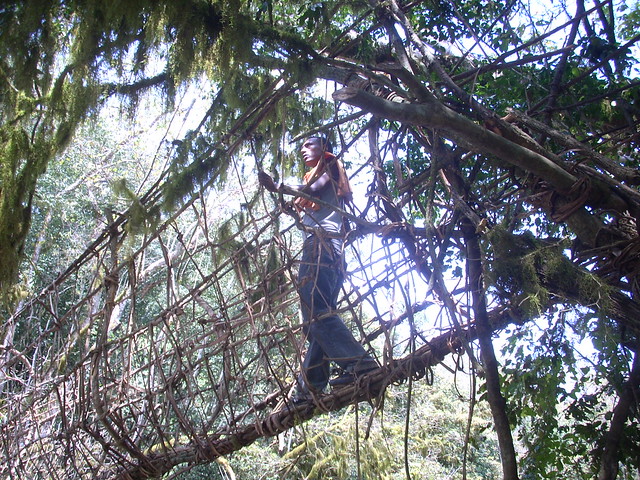
Near the Baro River, the trees and wildlife allow a glimpse into Ethiopia's past, when forests covered much more of the Ethiopian landscape than today. Within the forests and suspended over the Baro where trade and travel routes intersect are bridges made entirely from vines and branches. Beyond the spectacular scenery here, I have never eaten better honey or bananas anywhere else. In the photo above, my friend, Endalkachew, carefully tests a bridge before crossing.

On my first trip to the Baro, I came across two men who lived in the surrounding area. One of these men wore a faded and holey Nirvana T-shirt and had the ability to create an ember in less than a minute using only wooden sticks and the hand-drill technique.

I was carrying a Leatherman multi-tool at the time we met and took notice of the set of tools one of the men wore on a leather strap around his waist: 2 knives and a pair of sticks for fire craft (see photo). I was told by a friend who accompanied me to the river that the men in the area need only these tools when they go into the woods. I think I was impressed at their resourcefullness as much as they seemed impressed by the machined multi-tool I carried.

Saturday, March 31, 2012

Dinsho

Dinsho is situated near Bale National Park, southeast of Addis Ababa (Ethiopia’s Capitol). Dinsho is home of beautiful landscapes, the night cold, endemic animals, one of my favorite trees in Ethiopia, the kosso tree, and k’olo (a roasted barley snack). During my brief stay in Dinsho, I celebrated the dawn of 2012 with other Peace Corps Volunteers from around the country and got outdoors, into some elevation that pulled at my PNW love’n heart strings. Here are a few pictures from that trip:


Drew, Dressed for Dinsho Cold
Before we made it out there, we were advised to bring our warmest clothes and sleeping bags. But, living in the heat of southwest Ethiopia, I forgot what cold felt like. Down jacket, sweater, and windbreaker tightly bound with a wool scarf meant survival, not comfort. Drew, a PCV just a half days journey north of Dinsho, came prepared.


Entering a Kosso Grove
Sometimes nature shakes me and usually it’s from a mountain top but on occasion I’m amidst trees of unusual forms. The kosso tree (hagenia abyssinica) can be and often is gnarly and huge. Flowers grow in clusters from its limbs that seem like grapes from a distance.


Bale from Dinsho
The landscape is amazing and easily appreciated with a little elevation. The sunsets more than paid for the cold.

Tuesday, March 20, 2012

Lalibela


A couple of weeks ago, I traveled to the city of Lalibela with my parents. This trip was exciting for two reasons. First, I hadn't seen my mom or dad for over a year. Second, I had seen photos of the stone churches of Lalibela and known of its '8th wonder of the world' status long before knowing I would ever travel to Ethiopia.

We started our trip at an airport,which surprised me in its appearance of seeming like a bus station,waiting for favorable currents in a crowd to bring us closer to boarding our mode of transportation.


After arriving in Lalibela, we started our tour immediately by visiting the legendary churches and the town's marketplace. The rock hewn churches were amazing, consisting of entire buildings skillfully dug out of the ground and beautifully crafted by hand. I have never seen anything like it and recommend anyone spending any time in Ethiopia to make an effort to visit them. In addition, the market was one of the best I've been to in country (you start to get a feel for good markets based on products for sell, level of harassment, and ease of bartering and making friends with market vendors).


The second day during our stay in Lalibela, we took mules up a mountain, Ashetin Mariam, where a cave monestary was located and where I was able to hire a couple of local kids to take me up something of a scrambling trail to the very top. The landscape up there was something of a different world when comparing to my village town in Southwest Ethipia where short and soft rolling farmlands are the panorama. The weather, too, was very different and reminded me of the high sierras in California's Yosemite Park. After making it back down near the monestary, I joined my parents and the church's congregation in a communion of local beer and dark wheat bread: Delicious.


Our guide was exceptional, taking us everywhere we seemed interested and presenting the sites and sounds of Lalibela, each one better than the last. The photo above was taken at the last stop of our tour, St. George Church, which is supposedly one of the better crafted churches and possibly the most photographed (it's the only one currently not covered by a giant structure protecting it from the elements).

Thursday, February 16, 2012

Bus 4 Patience


A couple weeks ago, I set out to celebrate 5 birthdays (my own included) with volunteers whose sites were nearby. To get there the majority of us had go through the bus station in the zonal capital of Metu. Long story short, it was 11 hours of waiting that took place in the bus station, on the dirt road leading to said party site, and a in a junkyard before we got a ride.


It could have been worse. Company made the misery a bit more tolerable and besides it offered time to reflect on 28 years and the patience most often required to get anywhere worthwhile (The above photo is where we ended up- not such a bad place).